7 min
7 minFor this blog, we interviewed Kari - De Groene Mama (The Green Mum). In this blog, she tells you more about how she and her children stay healthy in autumn:
As I write this, my eldest daughter has just recovered. They were healthy all summer, but as soon as the schools reopened, the viruses came flooding back. Both girls have already had their first bouts of flu. ‘Autumn hasn't even started yet,’ I thought, ‘and already I have sick children clinging to me in the night.’ I decided to go back to basics and think about how we can get through autumn as healthily as possible with the children. In this blog, I share my 7 tips!
Sleep
When I think about the basics of health, ‘good sleep’ is one of the first things that comes to mind. If you don't sleep well, you don't have the energy to face life, the world looks different and it's harder to stay healthy. When I translate this to children, I think of a relaxed evening routine, with time to unwind after a long day, without screens, going to bed at fixed times and a healthy, clean and comfortable place to sleep.
My youngest, for example, really needs 12 hours of sleep, so she goes to bed at 7 o'clock every evening. My eldest, like me, has trouble quieting her mind in the evening. So we usually read together for an hour after her little sister has gone to sleep.
Food
Healthy food and eating habits are another basic element of a healthy life. For me and the children, this means a plant-based diet. We eat vegan at home. When we eat out, the girls eat vegetarian. Things that help me to ensure the children eat a healthy, plant-based diet:
- Don't save vegetables for dinner, but spread them out throughout the day. So put tomatoes, peppers, beans, cucumber, carrots and other raw vegetables in their bento boxes for school. Make nice snack plates with vegetables, fruit and nuts when they're at home. And give them vegetables at lunch. So instead of that boring peanut butter sandwich, keep wholemeal or vegetable wraps in the freezer, for example, heat them up and fill them with hummus and “easy” vegetables.
- Meal prepping! Very simple but effective vegetable meal preps help me to eat more vegetables and offer them to the girls quickly and easily. For example, by cutting and cooking the green beans in advance, cutting up raw vegetables and storing them clean in the fridge, washing and cutting lettuce and spinach in advance, and having one or two types of plant-based protein (such as lima beans and chickpeas) cooked and ready to go. I store everything in tightly sealed containers in the fridge. This makes it easy for us to eat vegetables with every meal, both at home and when we're out and about. If the ingredients are already prepared, they can easily be packed in a bento box, or I can whip up a tasty salad in a few minutes. I also often make my own muesli bars, which can also be packed in the bento box for school.
- Routine and experimentation. Children thrive on routine. For example, my girls like that Wednesday is wrap day and Friday is chip day. It's nice and clear, no fuss: it helps them to eat the vegetables that are served with these meals without any problems. In addition to the “easy” vegetables, I also try to experiment with vegetables that they don't know yet or find “difficult” to eat one or two days a week. My daughters are at an age (5 and 8) where I can explain how tasting and getting used to new things works and why some things are important or healthy. But I also think it's very important to avoid stress when it comes to food and mealtimes. This balance between routine and experimentation helps all three of us to keep things pleasant.
Supplements
I try to get as many important vitamins, minerals and protein from plant-based foods as possible and to eat/offer the children as balanced a diet as possible. I really see supplements as a support to healthy eating, not as a replacement. But children are fickle eaters. And as I said, I think it's important not to put pressure or stress on mealtimes.
In addition, some vitamins, such as B12, omega and vitamin D, are more difficult to obtain from vegan food. Finally, there are other reasons why you can develop deficiencies, for example during busy or stressful times. That is why I believe nutritional supplements are an important element, especially during the autumn and winter months.
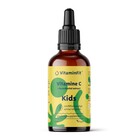
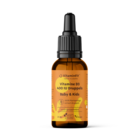
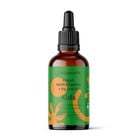
My girls get Vitaminfit drops every day. As I mentioned above, vitamin B12, vitamin D and omega 3, but also iron and, if their resistance is a bit low, I also give them vitamin C. What I like about Vitaminfit is that I can put together exactly what I want to give them, in the purest and most plant-based form, tailored to what my children need. The girls can now fill their own spoons with the drops and take them with some water. But you can also stir Vitaminfit drops into (vegan) yoghurt, quark, muesli or a smoothie, or even into soup!
Outdoors
Being outside, in nature, is so important for a healthy life. Not only physically, but also mentally. When I walk into a forest, all my problems disappear like snow in the sun. I see the children come alive, enjoying themselves, being in the here and now, admiring... Trees nourish us, nature nourishes us, the sun nourishes us, the sea air! It's all so essential for your health.
And yet society is not entirely geared towards this. We are locked up in offices and school buildings, even at the essential times for getting vitamin D from sunlight. One of the ways I try to be outside with the children as much as possible is by doing everything by bicycle. We don't have a car, so come rain or shine, we do everything by cargo bike and bicycle. Even in autumn! I also try to plan at least one day a week for the woods or the beach.
And then just playing outside a lot. I'm not really a playground mum myself – I find the average city playground boring and depressing, especially when it's cold in autumn. So I try to make it more feasible for myself by looking for nature playgrounds or playgrounds in the park or woods. When I'm surrounded by trees, I feel nourished, rather than drained.
Exercise
Exercise is also definitely one of the basic ingredients of good health. Exercise can be simple, of course: cycling or walking outdoors. But there are a number of other important elements to sport. A social aspect, for example: children make friends when they play sport. Good friendships are very important for your mental, emotional and therefore physical health. But they also learn to follow rules, deal with disappointment, work towards goals, overcome fears, you name it!
My parenting hack, especially as a single mother, is to get the children excited about the sports I do myself. So at the moment, my eldest daughter and I are bouldering. This is a climbing sport where you climb a 3 to 4 metre wall without a rope. Because I can do it while she's in class, I get to exercise myself. And I don't have to sacrifice precious time with the children for my hobbies.
Play dates
I mentioned it briefly earlier: social contacts and their impact on your health. We are social animals. Relationships have a big influence on how you feel. This quickly becomes clear when you feel lonely because you have few friends and family around you. Or when you have unhealthy relationships with people who cross your boundaries, do or say nasty things, or drain your energy. Just as I try to remain aware of which people and relationships have a positive or negative impact on my health, I also try to help the children with this.
As a parent, you are naturally cautious about guiding friendships. Children gravitate towards each other and, to a certain extent, you want to give them the freedom to form, explore and learn from these friendships. But I do try to talk to the girls about setting boundaries, their behaviour and that of other children, and specific experiences during interactions. This is, of course, a very nuanced issue and how you have these conversations with your children depends, among other things, on their age. But I do see it as one of my tasks as a mother to guide the children in their friendships, so that they can form healthy friendships and relationships now, but also later in life.
Rest day
Running, dashing, flying, falling and carrying on... Sometimes life with children is a big rollercoaster. From the morning rush, when everyone has to be at school on time with combed hair, brushed teeth and a healthy packed lunch, to the clubs and other activities you want to do yourself, to the evening routine with a healthy meal, reading stories and processing the day.
But how valuable is it to have a day where you don't have to do ANYTHING? Sleeping in together or cuddling in bed, lazing around, breakfast in bed, a day in pyjamas, doing crafts, messing around and yes, even being bored! Because so many wonderful things can come out of that boredom. A fantasy game with dolls, a construction with blocks that haven't been touched in a while, a “project” with shells and stones, delicious homemade muffins... That's why, in my opinion, rest days are the finishing touch to these building blocks for a healthy start to autumn and getting through it with the children!