4 min
4 minDo you take a multivitamin yourself and are you now looking for one for your child? A multivitamin can help children get all the important vitamins they need, but what exactly should you look for? In this article, we list everything you need to know so that you know what to look for when choosing a suitable multivitamin.
In this article, you will read
- Why a multivitamin can be important for your child
- Which vitamins deserve extra attention, such as vitamins A and B11
- Why a natural multivitamin is better than a synthetic one
- What is the advantage of a multivitamin in drop form
Why a multivitamin for your child?
A multivitamin supplement is an easy way to give your child a large portion of the 13 vitamins they need. This is especially useful when your child could use a little extra, because they are not eating well or enough. Vitamins are not produced in the body (with the exception of vitamin D and a small amount of vitamin K), so your child is dependent on the amount they get from food.
A common reason for not giving children multivitamin supplements is that some multivitamins contain more vitamin A and vitamin B11 (folic acid) than the recommended daily allowance. Consuming too much vitamin A can be harmful: it can cause poisoning in children.
Excessive levels of vitamin B11 in the body can also cause problems: it can mask a vitamin B12 deficiency. This does not mean that you cannot give your child a multivitamin supplement. It does mean that you need to know exactly what your child needs and does not need before you do so.
There are recommendations for the recommended daily allowance (RDA) of vitamins that children need. For vitamin A and vitamin B11, these are as follows:
Vitamin A | Vitamin B11/ folic acid | ||
0-5 months | 0 mcg | 0-5 months | 50 mcg |
6 months - 2 years | 300 mcg | 6-11 months | 60 mcg |
3- 5 years | 350 mcg | 1-3 years | 85 mcg |
6- 8 years | 400 mcg | 4-8 years | 150 mcg |
Unless your child gets 100% of these vitamins from food, it is therefore not a bad idea to give a child aged six months or older a multivitamin supplement. This is mainly because of the amount of vitamin A they need every day. Vitamin A is mainly found in animal products, such as liver sausage, eggs and fish. But vitamin A is also found in carrots.
Multivitamin supplements
Back to those multivitamin supplements that contain far too much vitamin A and B11. The Consumers' Association investigated this in 2019 and shows which multivitamins were tested. The Netherlands Food and Consumer Product Safety Authority (NVWA) ensures that dietary supplements available on the market are safe. Nevertheless, it is advisable to use your common sense when reading the product label.
A regular multivitamin prescribes a dosage that is suitable for an adult. It is therefore important to choose a special multivitamin for children. Here too, remain critical of the dosage prescribed on the label. If the dosage provides more vitamins than recommended (the RDA) for your child's age group, give less (in the case of drops) or choose another variant (in the case of pills).
Which multivitamin for children is best to choose?
In addition to reading the labels carefully when purchasing a multivitamin for children, there are two other points to consider:
1. A natural multivitamin is better absorbed than a synthetic one
This may sound logical in itself, but we would still like to explain why it is better to choose a natural multivitamin for children.
In short, a natural multivitamin is a vitamin based on 100% natural plants and herbs. This means that your child will not ingest any artificial additives. Synthetic multivitamins, on the other hand, consist of substances that are made (artificially) in a laboratory. The body does not absorb all the vitamins properly because it has difficulty recognising and absorbing the substances. Absorption can sometimes be as low as 20%.
Natural vitamins generally have an absorption rate of over 80% and sometimes even higher than 96%. So if you give your child a multivitamin supplement, you might as well do it right.
2. A multivitamin for children in drop form is easy to dose
It is advisable to choose a multivitamin in drop form for children, rather than in the form of (chewable) tablets. Not only can you determine the dosage very accurately yourself, but liquid vitamins are also absorbed by the body faster than tablets, and they are often more pleasant for children to use: a multivitamin in drops can easily be mixed into yoghurt, fruit juice or other food and drink products.
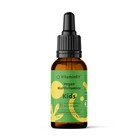
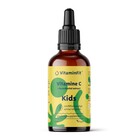
At VitaminFit, we have therefore developed a special multivitamin for children in drop form. A 100% natural and plant-based multivitamin, tailored to the needs of children and without any artificial additives. This way, you can rest assured that you are only giving your child(ren) natural nutrients.