4 min
4 minWe recently spoke to Kelly ten Velde MSc (37) from the Holistic Health platform, where she makes a special contribution to the health of families, women who want to become pregnant and women with intestinal complaints.
In addition to her work as an Orthomolecular Therapist and Holistic Health Coach, she is also the proud mother of two sons, Bram (5) and Sem (2). We talk to her about various topics related to our health and that of our children. This month's topic: immunity and the family.
Can you tell us how to better deal with our children's immunity?
Healthy nutrition is, of course, the most important thing for supporting your immune system. But we all know that getting children to eat well can be a challenge. In general, my children eat well, but dinner can sometimes be a struggle, and many parents can relate to that.
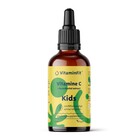
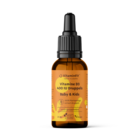
In addition to eating lots of fruit and vegetables, I use VitaminFit multivitamins specially formulated for children. Sometimes I choose a multivitamin with vitamin D and other times I choose a multivitamin without D. Then I give them vitamin D separately.
I always play around with this, depending on the season. It's really a matter of intuition. In the winter months, I often give them some extra vitamin D, and I find it easy to have your separate jars of vitamin D, so I can dose it separately. In the summer, I often use multivitamins with vitamin D in them. I use the vitamin C you have for that. It's a bit sour, but in the beginning, we turned it into a game where we made funny faces.
Now our children enjoy taking the sour vitamins. I just give them to them on a spoon and don't have to hide them anywhere. But it's perfectly fine to do so if your child doesn't want to take it directly from a spoon.
It's really fun to make a smoothie with your child every day. What's more, a smoothie is an easy way to boost your child's immune system.
You can hide lots of vegetables in it. Bananas and frozen fruit such as mango, raspberries and blueberries make the smoothie nice and sweet.
Then you can fill it up with leafy greens such as endive, kale, purslane or turnip greens. I often add herbs such as parsley, coriander or basil and avocado for healthy fats and creaminess.
Finally, you can add vitamins. Once they've drunk this, they've had enough nutrients, so it's not a big deal if they don't eat as well in the evening.
And while we're on the subject of supporting the immune system, I have another tip about what I wouldn't do. That is using an antibacterial hand gel.
Your skin also has flora, a skin microbiome. You don't want to disrupt that by removing all bacteria, including the good ones, with an antibacterial gel. Instead of hand gel, you can choose to wash your hands with soap that is as natural as possible and free of hormone-disrupting substances.
So, if we understand correctly, you use a multivitamin and alternate it with vitamin D?
I don't necessarily alternate it, but I mainly supplement it. Sometimes I choose to supplement vitamin D separately, other times I choose a multivitamin that already contains vitamin D.
I also give my sons vitamin C. I give them a little less in the summer and a little more in the winter, especially when it's “snot season”. Children almost always have a runny nose at that time of year. I give them extra vitamin C and lots of fruit every day.
Some people are afraid of fruit sugars or think that you should not eat more than two pieces of fruit a day. I don't entirely agree with that. I am actually a big advocate of eating lots of fruit.
Fortunately, my children love fruit and ask for it themselves. But you can also opt for a smoothie if your child doesn't like fruit or doesn't eat much of it. My sons really enjoy helping.
Seeing “cooking” makes them want to eat! They love cutting bananas, putting all the ingredients in the blender and turning the knob. Then they drink it with a metal straw, which they find extra fun.
They almost always ask me for more than one glass, even though I fill half the smoothie with all kinds of leafy greens, vegetables and herbs. Sometimes I hear from parents that they would like their child to be a little “fatter” so that they can cope better when they are ill. I often advise them to start with smoothies.
In any case, do not try to increase their weight by giving them extra biscuits. Many parents, as well as childcare centres, often have a set routine for the day.
The children eat fruit in the morning and a biscuit in the afternoon. Miffy biscuits, Liga biscuits, gingerbread; we often think these are healthier options, but they are just biscuits. Full of refined sugars, gluten and unwanted additives.
It is better to give them fruit and vegetables instead of biscuits. I'm not saying that my children never eat biscuits or sweets, but it's good to think about these kinds of habits and make conscious choices.
Do you add water or milk to the smoothies?
I choose water myself, because bananas and avocado already make the smoothie nice and creamy. If you don't do this, I would advise choosing unsweetened oat or almond milk.
In my practice, I once organised a challenge in which the participants drank a green smoothie every morning for 30 days. Many participants felt fitter just by making that change to their morning routine. They also had better bowel movements, which is an issue for many people. This autumn, I'm launching my new programme, Happy Belly, Happy You, aimed at women with intestinal complaints, and I will definitely be including topics such as a good morning routine and learning to read labels!
Do you have a fixed morning ritual with your children?
I think most parents will agree with me when I say that a fixed morning routine with small children often doesn't go as planned. That doesn't mean we don't have a morning routine, but it often turns out differently.
But usually it looks like this: We always start with something to drink, even before we eat, to flush out waste products. Then Bram and Sem play while one of us makes breakfast.
For a while, we gave them vitamins in the morning, but we often forgot because mornings can be hectic. Now we give them at dinner time. We put the jars on the table at dinner.
B vitamins are normally best taken in the morning. But if you often forget to do that, it's better to take them at another time than not at all. For us, the evening works well because it's a bit quieter then.
Does your family eat a vegetarian or vegan diet?
I was vegan for a year and a half, then I started eating a little meat again during my second pregnancy. I had such enormous cravings that I couldn't keep it up.
Beforehand, I thought I would go back to a vegan lifestyle after my pregnancy, but during my menstrual period I felt an extra need for meat. I noticed that I wasn't getting enough from plants.
I did the same for my children at the time; they too were vegan when they first started eating.
My eldest son hardly ate any dairy, meat or fish for the first 2 to 3 years of his life. Only when my mother stayed with us did meat appear on the table.
I also kept my youngest away from animal products for a long time, but I started to revise my views. So now we do eat animal products again, but only if they come from a really good source.
Of course, there are many different views on this, and there is enough research to support each of them. In my opinion, the most important thing is to listen to your own body. For me, those cravings during pregnancy were decisive.
And if you are vegan, it is definitely a good idea to supplement certain vitamins, such as vitamin B12 and Omega 3.
You posted something on Instagram about meat substitutes. What is your view on replacing meat by eating meat substitutes?
My advice is to make a choice and either eat meat or don't eat meat, but don't go for meat substitutes from the supermarket. Apparently, there is a need for something meat-like with meals, because many vegetarians still opt for meat substitutes.
However, these meat substitutes are often full of gluten, soya, emulsifiers, all kinds of ingredients to make them last longer and artificial flavourings. If you can find a burger without all that stuff, one made from black beans, herbs and spices, for example, that would be great. But unfortunately, I still haven't found one.
What would you recommend for children who eat vegetarian food? Beans, for example, can be quite difficult to feed to a very young child.
You could opt for vegan Omega 3 drops. I would also recommend vitamin B12 and a multivitamin with vitamin D. I gave these to my own children.
Would you like to take a look at Kelly's website and find out more via her Instagram? Then take a look at - www.holistischgezond.com or @holistisch.gezond.kelly